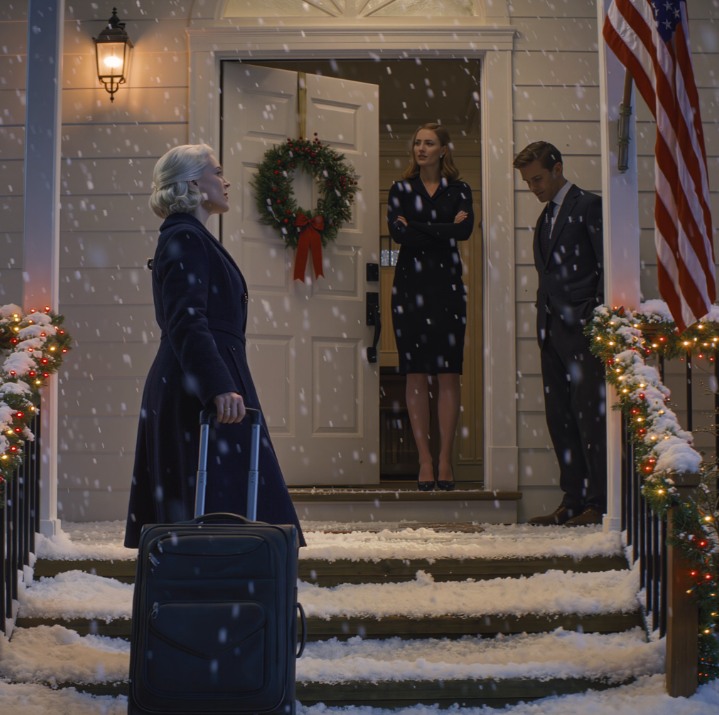
As I sat in my rental car watching the house, I realized they were having some sort of family meeting about me—presumably about what to do with the problem I’d become.
I walked to the front door and used my key. They hadn’t thought to change the locks, probably because it had never occurred to them that I might still have one. The voices from the living room stopped abruptly when they heard the door open.
“Hello,” I called out pleasantly. “I hope you don’t mind me letting myself in. It is my house after all.”
I found them arranged around the living room like a war council. Cynthia sat in what had been Richard’s favorite chair, still playing the role of matriarch. Marcus and Sarah flanked her, while David hung back near the window. There were two people I didn’t recognize—a middle-aged couple who looked distinctly uncomfortable.
“Alberta,” Cynthia said, standing up with forced dignity. “We were hoping you’d come by. We wanted to discuss a reasonable settlement to this whole misunderstanding.”
“Settlement?” I raised an eyebrow. “For what?”
“For the house, obviously. David and I have put a lot of work into this place. A lot of improvements. We think we deserve some compensation for—”
“You think you deserve compensation for living in my house rent-free for a week?”
The unknown couple exchanged glances. The woman cleared her throat nervously.
“Perhaps we should go, Cynthia. This seems like a private family matter.”
“No, please stay,” I said warmly. “I’m Alberta Morrison, Richard’s widow. And you are?”
“Tom and Linda Patterson,” the man said reluctantly. “We’re… we’re Cynthia’s parents.”
Ah. So they’d brought in reinforcements. Cynthia’s parents, probably told some version of events that painted me as the villain in this story.
“How lovely to meet you,” I said. “I hope Cynthia has explained the situation accurately.”
Linda Patterson looked between her daughter and me with obvious confusion.
“She said there was some sort of dispute about Richard’s will, about who gets what.”
“There’s no dispute,” I said calmly. “The will is very clear. Richard left modest bequests to his children and everything else to me. The only complication is that most of what people assumed was Richard’s property was actually mine all along.”
Tom Patterson frowned. “I’m sorry. I don’t understand.”
“Neither did they until a few days ago. You see, I’ve been financially independent since before I married Richard. The house they’ve been living in belongs to me. The comfortable lifestyle they’ve been enjoying was funded by my assets, not Richard’s.”
I watched the older couple process this information, watched their expressions change as they realized their daughter might not have been entirely truthful about the circumstances.
“But Cynthia said… you never worked,” Linda said slowly.
“I didn’t need to work in the traditional sense. I managed a rather substantial investment portfolio.” I smiled pleasantly. “About $47 million worth, as it turns out.”
The silence that followed was profound. Tom Patterson’s mouth actually fell open.
“So, when your daughter threw me out of this house the night Richard died,” I continued conversationally, “she was essentially evicting me from my own property. When she called me a blood sucker who never contributed anything, she was speaking to someone who had been supporting the entire family for years.”
Cynthia’s face had gone white. Her parents were staring at her with expressions of horror and disbelief.
“Cynthia Marie Patterson,” her mother said in the tone of voice that probably hadn’t been used since Cynthia was 12 years old. “Please tell me you didn’t actually throw this woman out of her own house at her husband’s funeral.”
“I—we—it’s complicated, Mom.”
“It’s not complicated at all,” I said gently. “Your daughter made assumptions about my financial situation and treated me accordingly. She’s now learning that assumptions can be expensive.”
Tom Patterson stood up, his face red with embarrassment.
“Mrs. Morrison, on behalf of our family, I want to apologize. If Cynthia did what you’re saying—”
“Dad, don’t—”
“If she treated you that way during your time of grief, then she was raised better than that and should know better.”
He looked at his daughter with disappointment that cut deeper than anger ever could.
“We’re leaving, Linda. This isn’t something we want to be part of.”
As Cynthia’s parents gathered their things and headed for the door, I could see the final pillar of her support system crumbling. She’d counted on them to back her up, to see her as the victim in this situation. Instead, they’d seen her for what she really was.
“Twenty minutes,” I announced to the room as the front door closed behind the Pattersons. “Then I’m changing the locks whether you’re finished or not.”
They scrambled then, grabbing bags and boxes they’d obviously packed in preparation for this confrontation. Sarah and Marcus avoided eye contact as they carried their belongings to their cars. David moved like a man in a trance, but Cynthia stood in the center of the living room, staring at me with something approaching hatred.
“This isn’t over,” she said quietly.
“Yes,” I replied, equally quiet. “It is.”
She left without another word, and I watched from the window as the cars pulled out of my driveway one by one. When the last taillight disappeared around the corner, I called Harold.
“It’s done,” I told him. “They’re gone.”
“How do you feel?”
I considered the question as I walked through my house, really looked at it for the first time since Richard’s death. It felt different now, lighter somehow, like a weight had been lifted from the very walls.
“I feel free,” I said finally. And for the first time in a week, that was absolutely true.
Six months after that final confrontation, I was sitting in my garden watching the sunrise paint my roses pink and gold when the phone rang. I almost didn’t answer. These days, I was much more selective about who I allowed into my peaceful mornings. But the number looked familiar, and curiosity won out over caution.
“Mrs. Morrison, this is Dr. Elizabeth Chen at Mercy General Hospital. I have a patient here asking for you.”
My blood ran cold. “Who?”
“David Holloway. He’s listed you as his emergency contact.”
Emergency contact. After everything that had happened, after the way his family had treated me, David had still listed me as the person to call in a crisis. Despite myself, I felt a familiar pang of maternal concern.
“What happened?”
“Car accident. He’s stable, but he’s asking for you specifically. Said to tell you it’s important.”
Twenty minutes later, I was walking through the sterile corridors of Mercy General, my heels clicking against the polished floor. I’d changed out of my gardening clothes into something more appropriate—a simple blue dress that Richard had always liked, paired with the pearl earrings he’d given me for our anniversary.
I found David in a private room, his left leg in a cast and his arm in a sling, but otherwise looking remarkably well for someone who’d apparently wrapped his car around a tree.
“Alberta.” His voice was soft, relieved. “You came?”
“Of course I came. You’re hurt.”
He tried to sit up straighter and winced.
“The nurse said they couldn’t reach Cynthia. Her phone’s been disconnected.”
I wasn’t surprised. In the months since they’d been forced out of my house, I’d heard through the small town gossip network that David and Cynthia’s marriage had imploded spectacularly. Apparently, learning that your financial security was built on lies and assumptions had put considerable strain on their relationship.
“Where is she now?” I asked, settling into the uncomfortable plastic chair beside his bed.
“Gone. She left three months ago, took what was left of our savings, and moved back in with her parents.” David stared at the ceiling, his voice hollow. “She said she married me for the lifestyle, not for me. When the lifestyle disappeared…”
“I’m sorry, David.”
“Are you?” He turned to look at me, and I was startled by the clarity in his eyes. “Even after everything we did to you?”
I considered the question seriously. Was I sorry? Six months ago, I would have said that Cynthia leaving was exactly what David deserved. But looking at him now—broken, alone, finally forced to confront the consequences of his choices—I found that I was genuinely sad for him.
“Yes,” I said simply. “I’m sorry you’re going through this.”
We sat in silence for a while, listening to the distant sounds of the hospital around us. Finally, David spoke again.
“I need to tell you something. About that night, when Cynthia threw you out.”
“David, you don’t have to—”
“Yes, I do.” His voice was stronger now, more determined than I’d heard it in years. “I knew it was wrong. Even as it was happening, I knew it was cruel and unfair. But I was so angry about the will, so disappointed that Dad had left us so little, that I let Cynthia convince me you were the problem.”
He paused, struggling with words that had obviously been weighing on him for months.
“You raised me, Alberta. From the time I was 12 years old, you were more of a mother to me than my biological mother ever was. You came to my soccer games, helped me with homework, stayed up with me when I was sick. And the night Dad died, when I should have been protecting you and comforting you, I let my wife call you names and throw you out onto the street.”
Tears were sliding down his cheeks now, and I felt my own throat tighten with emotion.
“I’ve been living with that guilt for six months, and I needed you to know that I remember who you really are. Not the rich woman with all the power—though God knows I understand that now, too—but the woman who bandaged my scraped knees and taught me how to drive and never once made me feel like I was less important than her biological children.”
I reached over and took his uninjured hand in mine.
“Oh, David.”
“I don’t expect you to forgive me,” he continued. “I just needed you to know that I see now what I threw away. Not the money or the inheritance or any of that. I threw away the one person in my life who loved me unconditionally.”
The tears I’d been holding back finally spilled over.
“You didn’t throw me away, honey. You made a mistake. A terrible, hurtful mistake, but not an unforgivable one.”
He squeezed my hand weakly.
“How can you say that after what we did?”
“Because I understand something now that I didn’t six months ago. That night when Cynthia threw me out, I thought my world was ending. I thought I was losing my family, my home, everything that mattered. But what I was really losing was an illusion.”
David frowned, not understanding.
“I thought I was part of a loving family where everyone cared about each other. But the truth was, I was part of a system where my value was based on what I could provide, not who I was. That night forced me to see the difference.”
I adjusted my grip on his hand, choosing my words carefully.
“You and your siblings and Cynthia—you didn’t know me at all. You knew the role I played, the function I served, but you never bothered to find out who I really was underneath. And because you didn’t know me, you couldn’t really love me. You loved what I did for you.”
David was quiet for a long moment, absorbing this.
“And now… now you’re seeing me for the first time as a complete person. Someone with her own history, her own strength, her own worth that exists independently of what I can do for others.”
I smiled at him through my tears.
“And I’m seeing you clearly, too, David. Not as Richard’s son or Cynthia’s husband, but as the young man I helped raise who’s finally learning to take responsibility for his choices.”
