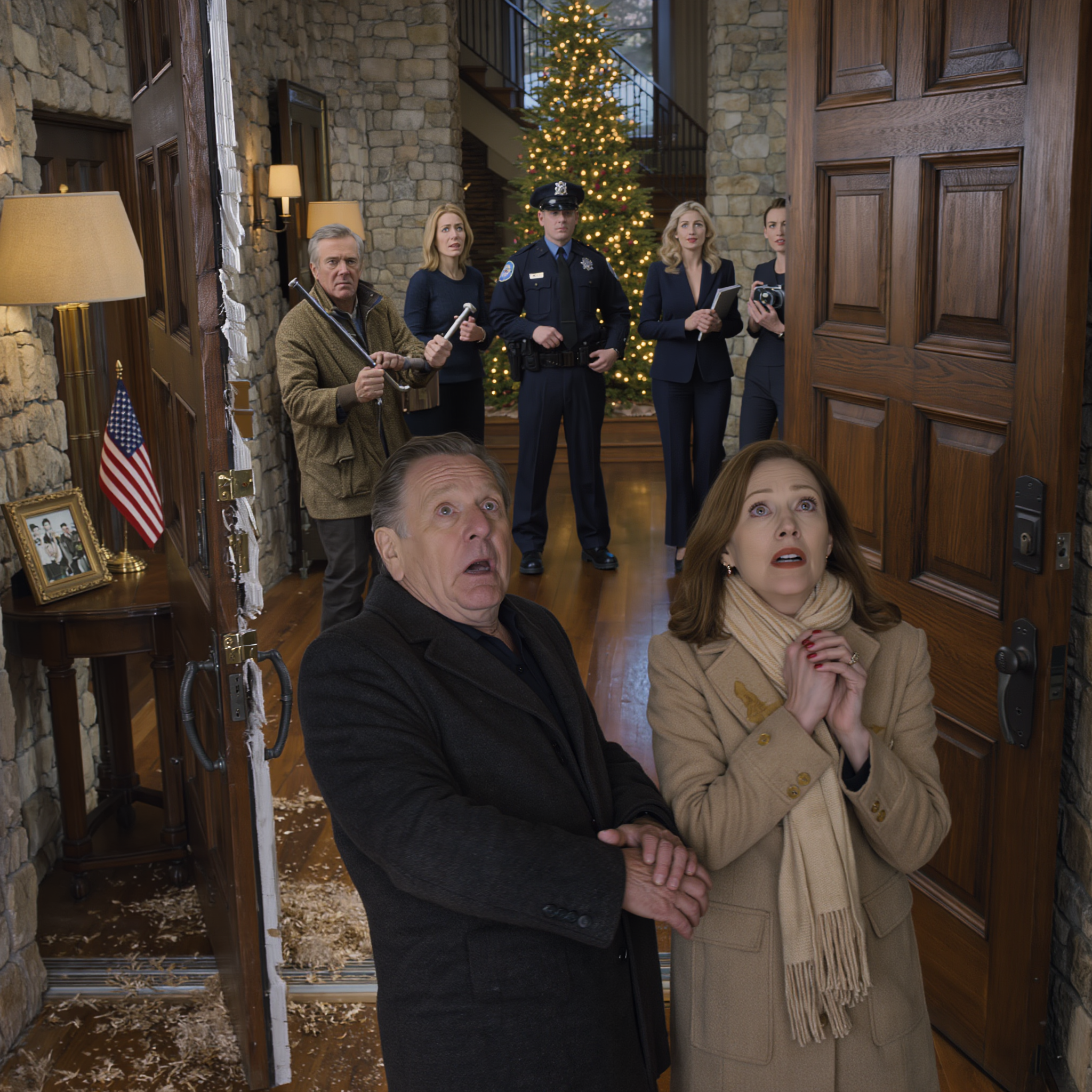
I walked past Grant and stood directly in front of my father. I held up the cream-colored card stock I had prepared.
I cleared my throat.
“Graham Caldwell, Marilyn Caldwell and Derek Caldwell,” I read aloud, my voice steady and cold, “you are hereby notified that you are permanently banned from the premises of 440 Blackwood Lane.
“This notice serves as a formal warning. Any further attempt to enter this property or any refusal to leave immediately constitutes criminal trespass under Penal Code Section 602.”
I handed the paper to Graham.
He didn’t take it. It fluttered to the floor, landing on the snow-dusted rug near his expensive Italian shoes.
“But we’re family,” Marilyn cried out, her voice shrill. “You can’t trespass family.”
I looked at her. I looked at the woman who had spent thirty years prioritizing her image over my existence.
“I just did,” I said.
From the corner of the room, Jim Miller stood up.
The original locksmith wiped his hands on his jeans and looked at Officer Tate.
“Officer,” Miller said, his voice heavy with regret but firm with resolve. “I want to go on record. Yesterday, these people hired me to drill the gate. They told me explicitly that the resident was suicidal and unconscious. That was a lie.
“They used a fabricated emergency to trick me into bypassing a security system.”
Officer Tate nodded. He looked at Graham.
“So we have a pattern,” he said. “Attempted entry by fraud yesterday. Forcible entry by destruction of property today.”
Tate turned his gaze to Derek. My brother was still holding the crowbar. He had lowered it, but he hadn’t dropped it. He looked like a trapped animal, his eyes darting from the police officer to the open door.
“And you,” Officer Tate said, walking slowly toward Derek. “You broke the doorframe. That’s felony vandalism. You entered with a weapon. That’s burglary. And judging by that phone in your pocket…”
Tate pointed to the rectangle of light glowing in Derek’s jacket.
“…you were broadcasting the whole thing.”
Derek’s hand flew to his pocket. He pulled out the phone. The screen was still active. The comments were scrolling by in a blur.
OMG is that the cops??
Dude you’re busted.
Delete the stream.
Derek fumbled with the phone, trying to end the broadcast, trying to erase the evidence of his own stupidity.
“Don’t touch that,” Tate barked.
Derek froze.
Officer Tate reached out and took the crowbar from Derek’s hand. It clattered to the floor with a heavy, final sound.
“Turn around,” Tate said. “Put your hands behind your back.”
“No,” Derek shouted, stepping back. “I didn’t steal anything! I just came to check the servers!”
“What servers?” Tate asked. “The ones you were ordered by the preservation council to remove yesterday?”
Derek looked at me. His eyes were wide with panic.
“Clare, tell him. Tell him it’s a misunderstanding. I’m your brother.”
I looked at him. I remembered the years of him stealing money from my purse and my parents blaming me for being careless. I remembered him crashing my car and my parents telling me I shouldn’t have left the keys out.
I remembered him erasing me from the family photos to make space for his trophies.
“I don’t know you,” I said. “I know a man named Derek who tried to steal my electricity and identity, but I don’t have a brother.”
The handcuffs clicked.
The sound was sharp and mechanical. It cut through the tension in the room like a knife.
Graham lunged forward.
“You can’t arrest him. He’s a minor—no, he’s young. He made a mistake.”
Officer Tate looked at Graham.
“He’s twenty-eight years old, sir. And you are under arrest, too.”
“Me?” Graham sputtered. “I didn’t break the door. I stood right here.”
“You directed him,” Tate said. “You hired the locksmith. You provided the fraudulent documents. That makes you a co-conspirator. Conspiracy to commit burglary is a felony, Mr. Caldwell.”
Tate pulled a second pair of cuffs from his belt.
“Turn around,” he ordered Graham.
Graham looked at the new locksmith, the one he had hired tonight. That man was already edging toward the door, trying to slip away into the night.
“Stay right there,” Tate yelled at the man without looking. “You’re an accessory. Sit on the bench.”
The man sat.
Graham Caldwell, a man who had spent his life believing that consequences were things that happened to other people, slowly turned around.
His cashmere coat bunched up as his wrists were locked together.
He looked at me over his shoulder.
The hate in his eyes was gone, replaced by a terrified confusion.
He genuinely could not understand how the world had flipped so completely.
Marilyn was the only one left standing free.
She stood in the center of the ruin of her family, her hands trembling.
She looked at Derek in cuffs. She looked at Graham in cuffs. She looked at the reporters and the neighbors.
She realized there was no one left to hide behind.
She turned to me.
Her face crumpled.
It wasn’t the fake, theatrical crying of earlier. It was the desperate, ugly sobbing of a woman who was losing her audience.
“Clare,” she wept. “How can you do this? Look at what you’ve done. You’ve destroyed this family.”
I didn’t answer. I didn’t have to.
From the shadows of the dining room, Andrea Mott stepped forward. She held up her phone.
“Actually, Mrs. Caldwell,” Andrea said, her voice cutting through Marilyn’s sobs, “you destroyed it yourself about three days ago.”
Marilyn looked at the reporter.
“Who are you?”
