“I’m the woman you emailed,” Andrea said. “You sent a tip to the Glenn Haven Gazette on December twentieth. You claimed that the new owner of the Blackwood Manor was a dangerously unstable woman and that the community should support the family’s efforts to intervene.”
Andrea scrolled on her phone and turned the screen so Marilyn could see it.
“You were setting up the narrative before you even arrived,” Andrea said. “You were planning to have Clare committed or discredited so you could take control of the property without questions.
“That’s not a wellness check, Mrs. Caldwell. That’s a premeditated conspiracy to defraud.”
Marilyn’s face went white. She looked like a ghost.
She had thought she was being clever, planting seeds of doubt in the press. She hadn’t realized that in a small town, the press talks to the people.
“I was just worried,” she stammered.
And then I played the final card.
I took my phone out of my pocket. I opened the audio file I had recorded yesterday, during the chaos at the gate—the one moment Graham thought I wasn’t listening.
I pressed play.
Graham’s voice filled the silent foyer, tiny but unmistakable.
“We need the address, Marilyn. If Derek doesn’t show the investors a facility by the first, they’re going to break his legs. We just need to get in, set up the rigs and take the photos. Once we’re in, Clare can’t kick us out. We’ll own the place.”
The recording ended.
The silence that followed was absolute.
Derek looked at Graham.
“You told Mom about the loan sharks?”
Graham looked at the floor.
Marilyn looked at Graham.
“You said it was just a cash flow problem,” she whispered. “You said we were doing this for his future.”
I looked at them.
The triangulation was complete. They were turning on each other. The unit was fractured.
Officer Tate spoke into his radio.
“Dispatch, I need two transport units to 440 Blackwood. I have three subjects in custody. Burglary, conspiracy, possession of burglary tools.”
“Three?” Marilyn asked, her voice a whisper.
Tate looked at her.
“You sent the emails, ma’am. You’re part of the fraud.”
He didn’t handcuff her yet. He likely ran out of cuffs. But he gestured for her to sit on the bench next to the terrified locksmith.
The flashing lights of the backup cruisers washed over the walls of the foyer, painting us all in blue and red.
The officers arrived.
They took Derek first. He was crying now, ugly heaving sobs, begging me to call the governor, begging me to tell them it was a prank.
I watched him go without a flicker of emotion.
Then they took Graham. He tried to walk with dignity, but it is hard to look dignified when you are being guided by the elbow by a deputy half your age.
He didn’t look at me. He looked at the floor.
Finally, a female officer approached Marilyn.
Marilyn stood up. She looked at me one last time. Her eyes were red. Her makeup smeared. She looked old.
“Clare,” she whispered. “Please. It’s Christmas.”
I looked at her. I looked at the woman who had forgotten me for seven years in a row. I looked at the woman who had sat at a warm table while I sat in a cold car.
I took a step closer to her.
“Christmas is a day for remembering, Marilyn,” I said softly.
I paused, letting the words hang in the cold air.
“But you only remember me when you need me. And I don’t need you anymore.”
I turned my back on her.
I heard the officer say, “Let’s go, ma’am.”
I heard the door close behind them.
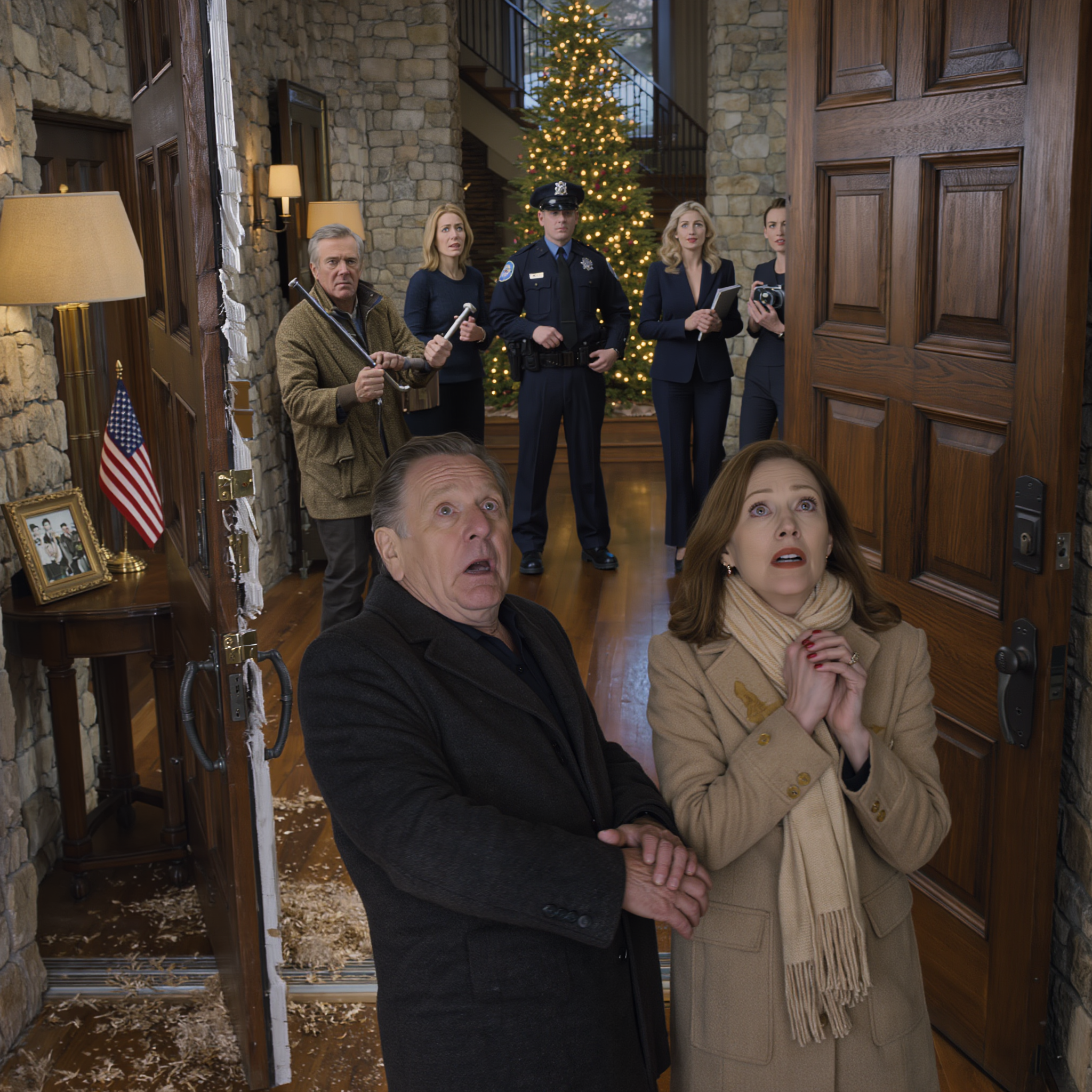
I stood there for a long time, facing the Christmas tree.
I heard the engines of the police car start up. I heard the crunch of tires on snow as they drove away, taking the toxicity out of my life.
Mile by mile. The house was quiet again, but it wasn’t empty. Arthur Abernathy cleared his throat.
“Well,” he said, his voice surprisingly gentle, “that was certainly a historic evening.”
I turned around. My guests were looking at me, not with pity—with respect. Andrea Mott closed her notebook.
“You know,” she said, “I think that’s enough news for one night. Off the record? That was incredible.”
Grant was pouring a fresh glass of wine. He held it out to me.
“To the landlord,” he said. I took the glass. My hand was steady.
I looked at the shattered doorframe. It would cost thousands to fix. The foyer was full of snow. The rug was ruined.
But as I looked around the room at the warm faces of the strangers who had stood by me, I felt a warmth bloom in my chest that I had never felt in my parents’ house.
I walked over to the stereo system I had set up in the corner. I pressed a button.
Soft jazz filled the room. The sound of a saxophone curled around the pillars, chasing away the memory of the shouting and the drilling.
I walked to the front door.
The wind was still howling outside, but the police lights were gone. The driveway was empty. The gate was broken, but the threat was gone.
I pushed the heavy oak door shut. It wouldn’t lock, but Officer Tate had promised to sit in his car at the end of the driveway for the rest of the night.
I turned the deadbolt as far as it would go—a symbolic gesture. Then I turned back to the room.
The lights of the Christmas tree reflected in the window glass, multiplying into infinity.
It was beautiful. It was mine. I raised my glass to the room. “Merry Christmas,” I said.
And for the first time in thirty-five years, I knew that I would be remembered—not as a victim, not as an afterthought, but as the woman who bought a manor, fought a war, and won her own peace.
I took a sip of the wine. It tasted like victory. Thank you so much for listening to this story. Take care. Good luck.
