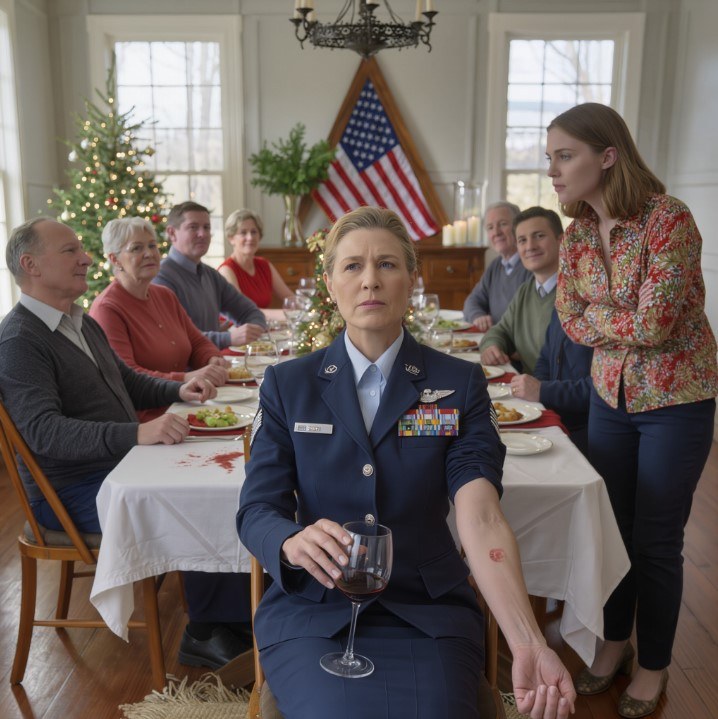
“Mom, this isn’t your fault. You were shocked. Everyone was. I was shocked.”
She agreed. But I’ve also been watching her treat you differently for months now. The comments, the little digs. I told myself I was imagining it, that you two just had different personalities. But I wasn’t imagining it, was I?
“No.”
She let out a long breath. “Your father and I talked about it. We’re not having her here for a while. Not until she makes this right with you.”
I hadn’t asked them to take sides. Hadn’t wanted them to. But hearing my mother choose to see the situation clearly, to prioritize my well-being over keeping peace—it meant more than I expected.
“Thank you,” I said quietly.
Daniel called again the following week. He sounded exhausted.
“She’s not handling this well. She thinks everyone’s turning against her.”
“People are responding to her behavior, not conspiring against her.”
“I know. I told her that. She doesn’t want to hear it.” He paused. “She keeps saying you’re overreacting. That it was one mistake, that she apologized.”
“Daniel, what did she actually apologize for?”
Silence.
“I don’t know. The text, I guess.”
“Read it to me. Tell me what part of that text acknowledges what she did.”
I heard papers shuffling, his phone screen lighting up. He read it aloud and I heard him realize mid-sentence what I’d already seen. It was a performance of apology, not the thing itself.
“She really hurt you,” he said finally. It wasn’t a question.
“Yeah, but more than that, she showed me how she sees me, how she’s probably always seen me. My service isn’t something she respects. It’s something that makes her uncomfortable because it doesn’t fit into her framework of success. And instead of examining that discomfort, she turned it into judgment of me.”
“I think you’re right,” he said quietly.
“About which part?”
“All of it.”
That conversation marked a shift. Daniel stopped defending Karen’s actions and started acknowledging them. It didn’t fix anything immediately, but it changed the foundation we were standing on.
Meanwhile, my professional life continued its own trajectory, indifferent to family drama. My promotion to lieutenant colonel came through. The board results were posted on a Friday morning, and by that afternoon, I had congratulations emails from commanders across three time zones. Colonel Butcher called personally.
“Knew it would happen,” she said. “You’ve earned this 10 times over, Solomon.”
“Thank you, ma’am.”
“How’s the arm?” She always asked.
“Same, manageable.”
“Good. Keep managing it and keep leading. We need officers like you.”
The promotion felt like validation from the people whose opinions actually mattered—fellow service members, commanders who understood the work and sacrifice, airmen who I’d led and trained and trusted with difficult missions. Their respect had never wavered. They saw my injury for what it was, evidence of service, not evidence of failure.
The contrast between that professional recognition and Karen’s contempt became starker. In the Air Force, I was Lieutenant Colonel Solomon, officer with 18 years of service, combat veteran, leader of personnel. In Karen’s framework, I was just a woman with a shaking hand who showed up to family events in a uniform that made her uncomfortable. I realized I’d been trying to make her see me the way my colleagues did, but that was never going to happen because we were measuring worth on completely different scales.
Three months passed. I attended family gatherings at my parents’ house, small dinners, holiday celebrations without Karen present. Daniel came alone sometimes, brought the kids other times. We didn’t talk about the absence, just worked around it. Karen’s attempts at contact became less frequent—a message here, a social media like there, small gestures that seemed designed to maintain connection without actually addressing the rift. I ignored them all, not out of spite, but because engagement without resolution felt dishonest.
I wasn’t angry anymore. That was the surprising part. Somewhere in those months, the anger had burned off, leaving something clearer and calmer. I didn’t need her to understand what she’d done. I didn’t need her to validate my service or acknowledge my sacrifice. I only needed to stop accepting her judgment as meaningful.
The tremor in my hand still flared up. Cold mornings, long duty days, anytime my body was tired or stressed. I stopped hiding it, stopped positioning my hands strategically or making excuses when it happened. At a staff meeting, my hand shook while I was pointing at a tactical display. A young lieutenant noticed and hesitated, clearly unsure whether to acknowledge it.
“Nerve damage,” I said casually. “Kandahar. Doesn’t affect my judgment, just my motor control sometimes.”
She nodded and we moved on.
That simple acknowledgement, treating it as a fact rather than a flaw, felt revolutionary. I’d spent years minimizing the injury, trying not to let it define me or limit me. But pretending it didn’t exist was just another form of shame. The injury existed. It was part of my story, and it didn’t diminish me.
