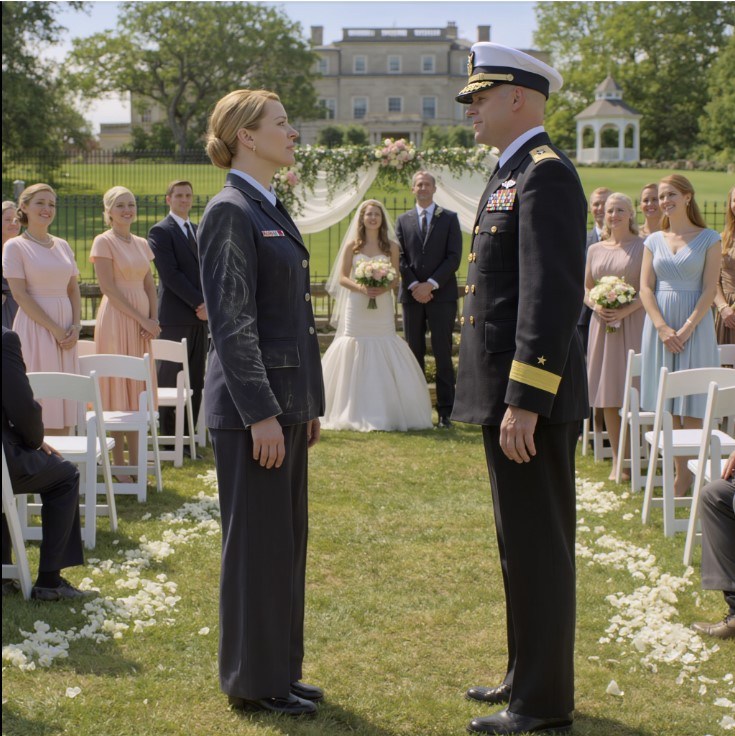
Maar die wetenschap maakte het niet makkelijker.
‘Ze vroeg me om morgen mijn uniform niet te dragen,’ voegde ik eraan toe.
“Naar de bruiloft van je eigen zus?”
‘Naar het repetitiediner,’ verduidelijkte ik. ‘Ze zei dat het ‘de aandacht zou trekken’.’
Reyes maakte een geluid dat zowel een lach als een spottende opmerking kon zijn.
‘Weet je wat de aandacht trekt?’ zei ze. ‘Onzekerheid. Je zus zal dat op de harde manier leren.’
We praatten nog een paar minuten door, voornamelijk over zaken en aankomende evaluaties. Het vertrouwde ritme van werkgerelateerde gesprekken stelde me gerust.
Toen we ophingen, voelde ik me weer meer mezelf. Minder als de teleurstellende oudere zus. Meer als de agent die ik in decennia had willen worden.
De bruiloft was morgen.
Ik zei tegen mezelf dat ik gewoon nog één dag moest doorkomen.
Ik werd uit gewoonte om 6 uur ‘s ochtends wakker, ook al hoefde ik tot 12 uur ‘s middags nergens te zijn.
Het was stil in huis, op mijn moeder na die beneden rondliep, waarschijnlijk koffie aan het zetten en zich zorgen makend over details waar ze geen invloed op had.
Ik bleef langer dan normaal in bed liggen, staarde naar het plafond en probeerde me mentaal voor te bereiden op wat de dag zou brengen.
Mijn dienstuniform, blauw, hing in de kast.
Ik had het meegenomen ondanks Melines bezwaren. Een koppig deel van mij weigerde het helemaal achter te laten.
Het uniform voelde als een pantser – niet tegen fysieke bedreigingen, maar tegen de versie van mezelf die mijn zus van me wilde maken.
Klein. Verkleind. Makkelijk te verklaren.
Ik stond op, nam een douche en trok de jurk aan die ik tijdens het repetitiediner had gedragen. Hij was prima. Gepast. Onopvallend.
Precies wat Meline wilde.
Beneden had mijn moeder het ontbijt klaargezet: bagels, fruit en koffie.
Mijn vader zat aan tafel en las het nieuws op zijn tablet, af en toe kijkend naar de trap alsof hij wachtte tot er iets ergs zou gebeuren.
Hij was veertig jaar lang docent op een middelbare school geweest, had een goed gevoel voor spanning en wist wanneer hij moest zwijgen.
‘Een belangrijke dag,’ zei mijn moeder, terwijl ze een mok voor me neerzette.
‘Het zal prachtig zijn,’ zei ik automatisch.
Ze aarzelde even en ging toen tegenover me zitten.
‘Je zus heeft veel stress,’ zei ze.
« Ik weet. »
“Ze meent sommige dingen die ze zegt niet.”
Ik bekeek haar aandachtig.
‘Welke dingen precies?’ vroeg ik.
Op het gezicht van mijn moeder verscheen een uitdrukking die op schuldgevoel leek.
« Ze maakt zich alleen maar zorgen over het maken van een goede indruk, » zei ze. « De familie Mercer is… tja, ze zijn een bepaalde standaard gewend. »
‘En u denkt dat ik niet aan die norm voldoe?’
“Dat is niet wat ik zei.”
‘Maar dat is wat Meline denkt,’ zei ik.
My father lowered his tablet.
“Julia,” he said, “your sister has always been intimidated by you. You have to know that.”
The statement caught me off guard.
“Intimidated?” I repeated. “She acts like I’m an embarrassment.”
“Because she’s intimidated,” he said again. “You’ve accomplished things she can’t even conceptualize. She doesn’t know how to relate to you anymore, so she diminishes what you do. It’s not right, but it’s what she does.”
I’d never heard him articulate it that clearly before.
“She told someone I ‘work in logistics,’” I said. “She made it sound like I’m a supply clerk.”
My mother winced.
My father just nodded, unsurprised.
“Are you going to say something to her?” I asked.
“Would it help?” he said.
I thought about that.
“Probably not,” I admitted.
“Then we’ll get through today,” he said, “and then things will settle down.”
I wanted to believe that.
But sitting at that kitchen table, I had the distinct feeling that things wouldn’t settle down.
They’d just calcify into whatever shape they’d already taken.
Meline would continue treating me like a supporting character in her life. My parents would continue smoothing over the tension without addressing it. And I’d continue showing up, absorbing it, because that’s what I’d always done.
At 11:30, we drove to the venue—a renovated estate with gardens and a view of the hills.
Meline had chosen it for its elegance and its exclusivity. Only 150 guests, all carefully selected.
I’d seen the seating chart.
I was at Table 12 near the back, with distant cousins and family friends who wouldn’t ask complicated questions.
The bridal suite was chaos.
Meline sat in front of a mirror while two people worked on her hair and makeup simultaneously. Bridesmaids fluttered around, adjusting dresses, looking for lost earrings, taking endless photos.
Someone handed me a glass of champagne I didn’t want.
Meline caught my reflection in the mirror. Her eyes went to my dress, scanning for any detail that might be wrong or attention‑seeking.
Finding nothing to criticize, she looked away.
“Has the general arrived yet?” one of the bridesmaids asked.
“Evan texted twenty minutes ago,” another replied. “He’s on his way from the airport.”
The energy in the room shifted.
Everyone seemed to stand a little straighter, speak a little more carefully.
General Mercer’s presence hung over the day like a weather system we were all tracking.
Meline’s hands were shaking.
The makeup artist told her to hold still, but she couldn’t seem to manage it. She kept checking her phone, reading and rereading messages from Evan.
“He’s going to love everything,” one of the bridesmaids said. “You’ve planned the perfect day.”
Meline didn’t look convinced.
She looked terrified.
Thirty minutes before the ceremony, I stepped outside for air.
The gardens were filling with guests, military families in dress uniforms, civilians in formal wear, a photographer capturing details.
I found a quiet corner near the rose beds and tried to center myself.
That’s when Meline found me.
She walked over quickly, her dress swishing against the stone path.
Her face was tight with barely controlled anxiety.
“I need to talk to you,” she said.
“Okay,” I replied.
She glanced around, making sure no one was close enough to hear.
“The general is here,” she said. “He’s in the venue with Evan and Mrs. Mercer.”
“That’s good,” I said. “Everything’s ready.”
“Julia.”
She stepped closer, her voice dropping.
“I need you to understand something,” she said. “This family is very important. Very connected. I can’t have anything go wrong.”
“Nothing’s going to go wrong,” I said.
“I mean it,” she insisted. “I need you to stay out of the way. Don’t talk to the general. Don’t try to introduce yourself or make conversation. Just… be invisible.”
I stared at her.
“You want me to be invisible at your wedding?” I asked.
“I want you to not embarrass me,” she snapped. Her voice cracked slightly. “Please, Julia. For once in your life, can you just not make everything about you?”
The unfairness of it hit me like a physical force.
I’d spent the entire weekend—the entire engagement, really—making sure nothing was about me. I’d paid for things, shown up for things, absorbed her stress and her insults without pushing back.
And she was standing here, thirty minutes before her ceremony, telling me I made everything about myself.
“I’ve never made anything about me,” I said quietly.
“You don’t have to try,” she shot back. “You just exist and everyone pays attention. Meanwhile, I’ve worked my whole life to get to this point, and I need you to let me have this.”
“Meline—”
“Stay away from the general,” she said. Her voice went hard. “Don’t introduce yourself. Don’t try to talk about the military or impress him with your job. You are a nobody here. Do you understand?”
A nobody.
Several people had stopped nearby, close enough to hear.
I saw a bridesmaid’s eyes widen. One of the vendors pretended to adjust a flower arrangement while clearly listening.
Meline didn’t seem to care.
She was too far into her panic to notice or care about who heard.
“Don’t embarrass me,” she said again.
Then she turned and walked back toward the bridal suite, leaving me standing alone in the garden.
I stayed there for a long time, feeling the weight of what she’d said settle into my chest.
Not the words themselves—I’d heard worse in command situations—but the casual cruelty of them. The ease with which she’d reduced me to nothing in order to make herself feel bigger.
A nobody.
Thirty years of service. Three deployments. Two combat ribbons. A Bronze Star. A promotion record that put me in the top five percent of my cohort.
And my sister saw me as a nobody.
I walked slowly back toward the venue, my mind quiet and clear.
I wasn’t angry.
I wasn’t hurt, exactly.
I was simply… finished.
Finished pretending her behavior was acceptable.
Finished making excuses.
Finished being small so she could feel big.
The ceremony would start soon. I’d stand in my assigned spot, smile for the photos, and fulfill my role.
But something fundamental had shifted.
