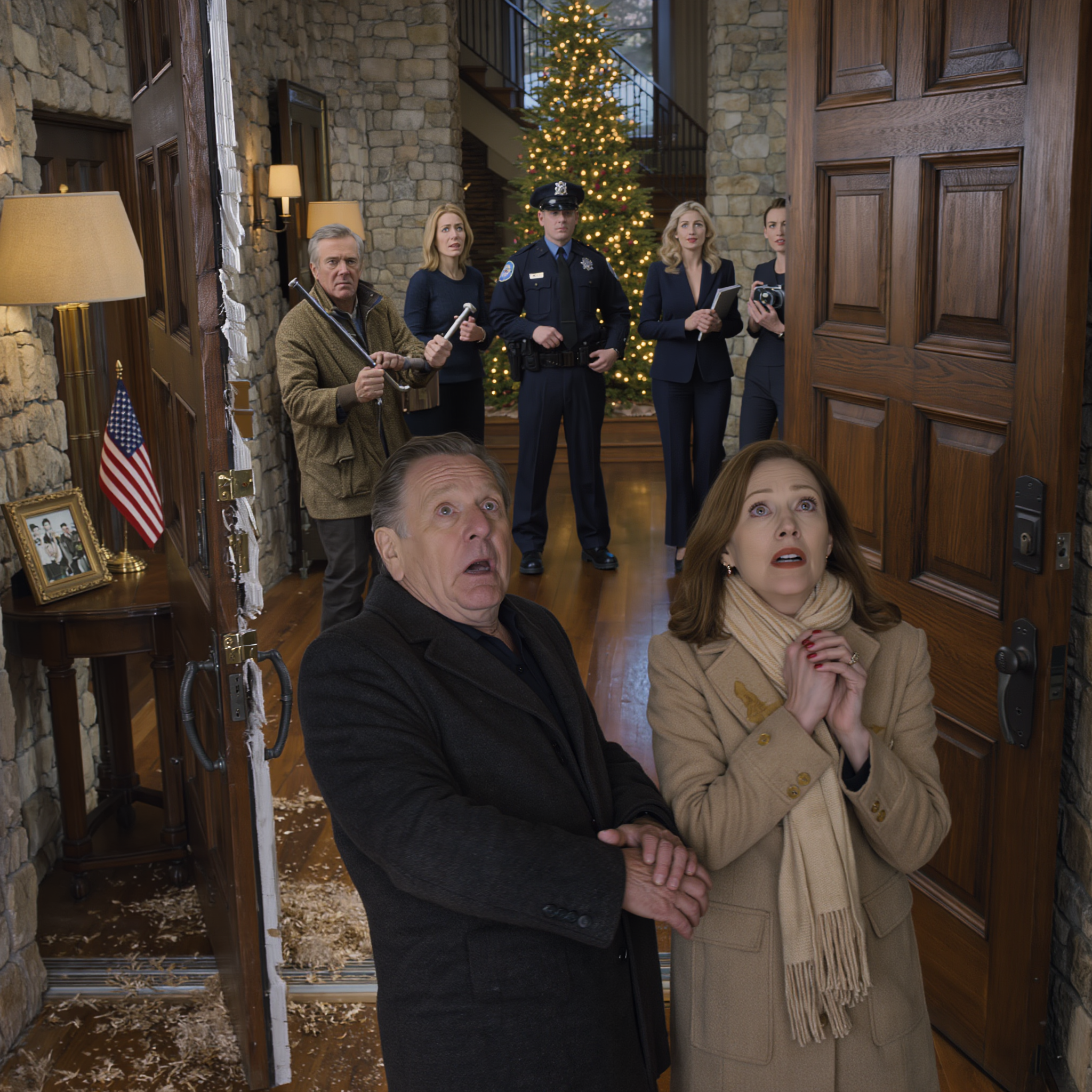
“I’m hosting a party,” I said. “The Heritage Holiday Open House. It’s a legitimate event under the trust’s charter. I’m inviting the historical society. I’m inviting the preservation council. I’m inviting you.”
Andrea stared at me, and then she laughed. A loud, genuine laugh.
“You’re going to fill the house with the very people who can arrest them,” she said.
“Exactly,” I said. “But here’s the trick. The front of the house must remain dark. No exterior lights, no wreaths on the door. To anyone watching from the street, it must look like I’ve given up and fled. I want them to think the fortress is abandoned.”
“It’s a trap,” Andrea said.
“It’s a surprise party,” I corrected.
By the next morning, the twenty-fourth of December, the plan was in motion.
It was a strange feeling. Usually, on Christmas Eve, I was invisible. I was the ghost in my parents’ house, avoiding eye contact, waiting for the night to end. Today, I was a general.
I spent the morning cleaning the main hall, not for my mother’s approval, but for my allies. I set up a long table in the dining room. Instead of a turkey, I laid out documents: copies of the deed, copies of the preservation orders. It was an exhibit of my ownership.
At two in the afternoon, Arthur Abernathy arrived with three members of the historical society. They brought wine and cheese, but their eyes were sharp. They walked around the property, inspecting the gate, tutting at the drill marks, shaking their heads at the tire tracks on the lawn.
They were not there to celebrate the holidays. They were there to defend the district. They were my infantry.
At four o’clock, the private security arrived.
I had hired him through a contact of Grant’s. His name was Officer Tate. He was off duty, meaning he was in plain clothes, but he carried his badge and his service weapon on his belt.
He was not there as a favor. He was there as a paid contractor, instructed to enforce the trespassing laws to the letter.
“I want you in the library,” I told him. “If they breach the door, you do not engage immediately. Wait until they are inside. Wait until they have committed the act of breaking and entering.”
Tate nodded. He was a man of few words, which I appreciated.
“You want them to hang themselves,” he said.
“Metaphorically,” I said.
By six o’clock, the house was full.
There were twelve of us in total.
Andrea Mott sat in the kitchen, her laptop open, ready to record.
Arthur Abernathy and his cohorts were in the parlor admiring the original crown molding and drinking the expensive wine I had bought.
Jim Miller, the locksmith, had even shown up, looking sheepish and holding a fruitcake as a peace offering. He sat by the back door, ready to identify Graham the moment he walked in.
But the house was silent.
I had given strict orders: no music, no loud laughter. We kept the heavy velvet drapes drawn tight. From the outside, Blackwood Manor was a black hole.
The windows were dark. The porch light was off. The snow on the front steps was undisturbed. To any observer, it looked like the heat was still off. It looked like the crazy daughter had retreated to a hotel or a hospital, leaving the prize unguarded.
I stood in the foyer, in the shadows of the grand staircase. I was wearing a black dress, simple and severe. I wasn’t wearing it for them. I was wearing it for me.
I looked at the Christmas tree I had set up in the corner of the great hall. It was a live spruce, twelve feet tall, smelling of winter and sap. I hadn’t put any of the family ornaments on it. No macaroni stars made by Derek in kindergarten. No fragile glass baubles handed down from Marilyn’s grandmother.
I had decorated it with white lights and simple crystal icicles. It was cold, elegant and strong.
For thirty-five years, Christmas had been a performance of a happy family that didn’t exist. It had been a minefield where I had to tiptoe around their egos, their neglect, their sudden biting criticisms.
I touched a branch of the tree. The needles were sharp against my fingertips.
This year, I wasn’t tiptoeing.
I had built a wall. I had built it out of strangers who cared more about the law than my parents cared about me. I had built it out of paper and ink and zoning codes.
Grant Holloway texted me at 6:30.
I am on standby. Phone is on loud. Good luck, Clare.
I put the phone in my pocket.
I looked around the room at my strange, motley collection of guests: a reporter, a guilt-ridden locksmith, a group of elderly preservationists, a hired gun.
They were not my family, but tonight they were my people. They were the witnesses to my reality.
At seven o’clock, the motion sensor on the front gate pinged my phone.
The house went deathly still.
In the parlor, Arthur Abernathy put down his wine glass. In the kitchen, Andrea Mott hit the record button on her voice memo app.
Officer Tate stepped out of the library and stood in the shadows of the hallway alcove.
I walked to the window and peered through the crack in the curtain.
A car was moving slowly down the street. It didn’t have its headlights on. It was prowling.
It was a rental truck this time, a large, boxy moving truck. They hadn’t just brought the servers. They had brought furniture. They were planning to move in fully.
The truck paused at the gate. I saw a figure jump out. It was Derek. He didn’t bother with the keypad this time. He had a pair of bolt cutters.
I watched as he snapped the chain I had draped across the gate earlier that day. It was a dummy chain meant to look pathetic and easily defeated.
He cut it.
The gate swung open. The truck rolled through.
I turned back to the room.
My heart was pounding, but it wasn’t the erratic rhythm of panic. It was the heavy, powerful beat of a gavel coming down.
“Get ready,” I whispered to the darkness.
The truck rumbled up the drive. The engine cut. I heard car doors slam. I heard muffled voices.
“Just break the window near the latch,” I heard Derek say. “It’s cheaper to replace glass than a lock.”
“Do it quick,” Graham’s voice hissed. “It’s freezing.”
I stood in the center of the foyer. My hands were clasped in front of me. I waited for the sound of shattering glass.
I looked at the tree one last time. The white lights twinkled in the gloom.
“Merry Christmas, Mom and Dad,” I thought. “Welcome to the open house.”
The house was breathing. That was the only way I could describe it.
For decades, Blackwood Manor had stood empty, a hollow shell of limestone and oak. But tonight, it felt alive. It was holding its breath, just as I was, waiting for the infection to return so it could finally be purged.
I stood in the library, which I had converted into a temporary command center. The heavy velvet curtains were drawn tight, blocking any spill of light onto the snowy lawn outside.
On the desk, my laptop screen was split into a grid of six distinct feeds. The night-vision cameras that Dave, the electrician, had installed so discreetly were working perfectly.
They painted the world outside in shades of ghostly green and sharp, high-contrast black. I could see the individual snowflakes drifting down onto the driveway. I could see the tire tracks from the rental truck that Derek had driven earlier, now filled with fresh powder. I could see the iron gate currently standing open where he had cut the chain, looking like a broken jaw.
Inside, the atmosphere was a surreal blend of cocktail party and stakeout.
The air smelled of expensive merlot, beeswax candles, and the faint nervous perspiration of my guests.
I had asked everyone to keep their voices down, and they had complied with a solemnity that bordered on religious.
In the parlor, Arthur Abernathy sat in a high-backed wing chair, swirling a glass of red wine. He was looking at the original crown molding with a critical eye, occasionally whispering to Mrs. Higgins about the tragic state of the plasterwork.
They were not just neighbors. They were the jury.
They represented the history of Glenn Haven, the very thing my family was coming to defile. They were insulted personally by the presence of industrial servers in a preservation district, and their indignation was a palpable force in the room.
